The Operations Layer for Supply Chains That Already Bought Compliance
Your serialization platform finds the problem. Your EDI translator rejects the transaction. Your master data breaks somewhere upstream. vSMAART connects the systems you already own, gives their data shared meaning, and resolves what breaks — with AI that says how confident it is, and asks a human when it isn't.
We Don't Replace Anything You Already Own
The pharma supply chain software market spent a decade selling compliance achievement — serialization platforms, EPCIS repositories, partner networks. For most companies, that purchase is done. What's never been sold is the layer that handles what those systems produce every single day. That's vSMAART.
No Rip and Replace
No L4 migration, no steering committee, no multi-year project. vSMAART attaches to the serialization, ERP, and EDI systems already in place.
A Different Budget
Funded from operations and revenue — not the capital compliance program your team already spent and closed out.
Zero Lock-In, by Design
We're architecturally required to work with whatever you have. That's the product, not a talking point.
Platform in Action
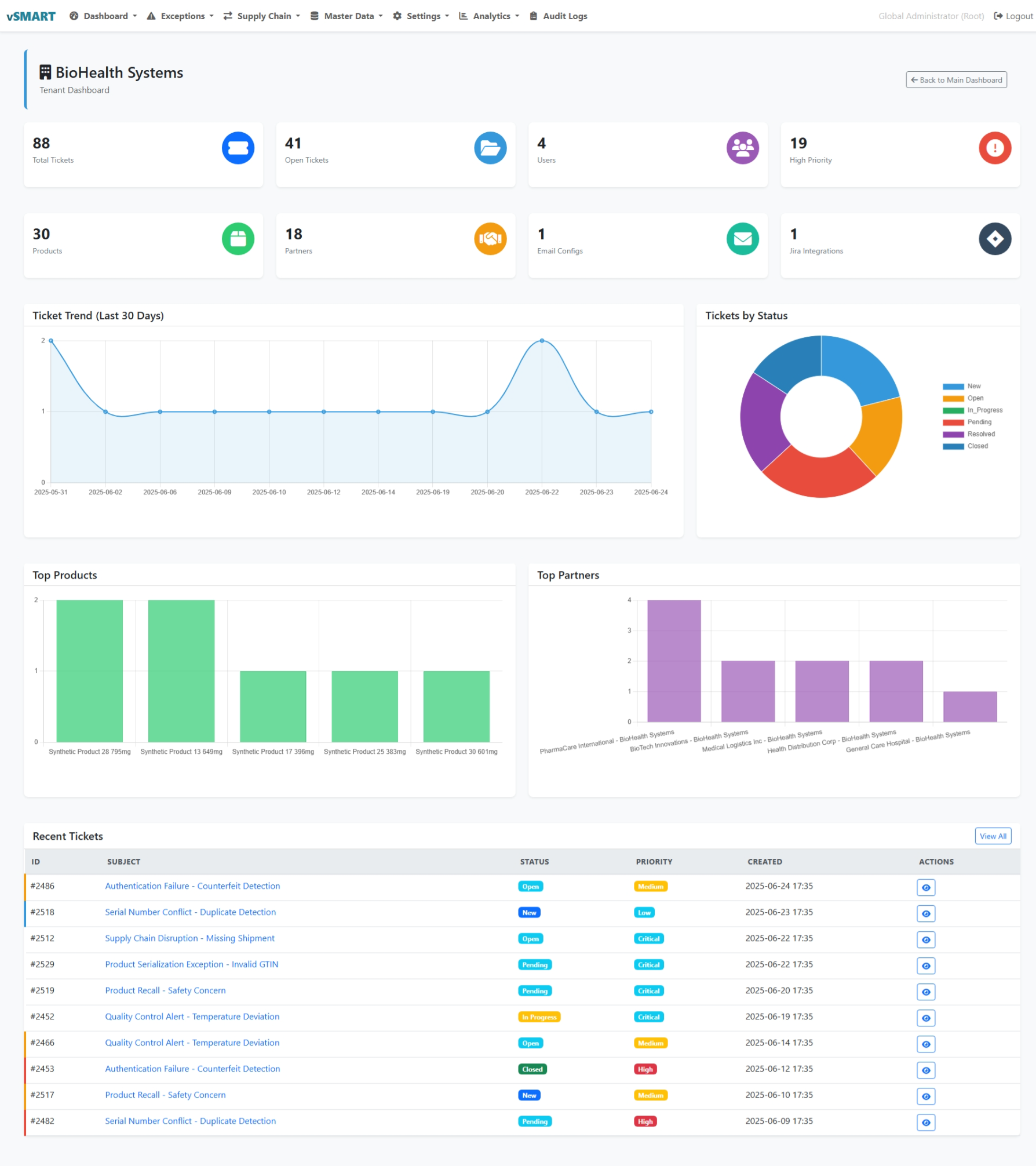
Case & Exception Monitoring (CheQD)
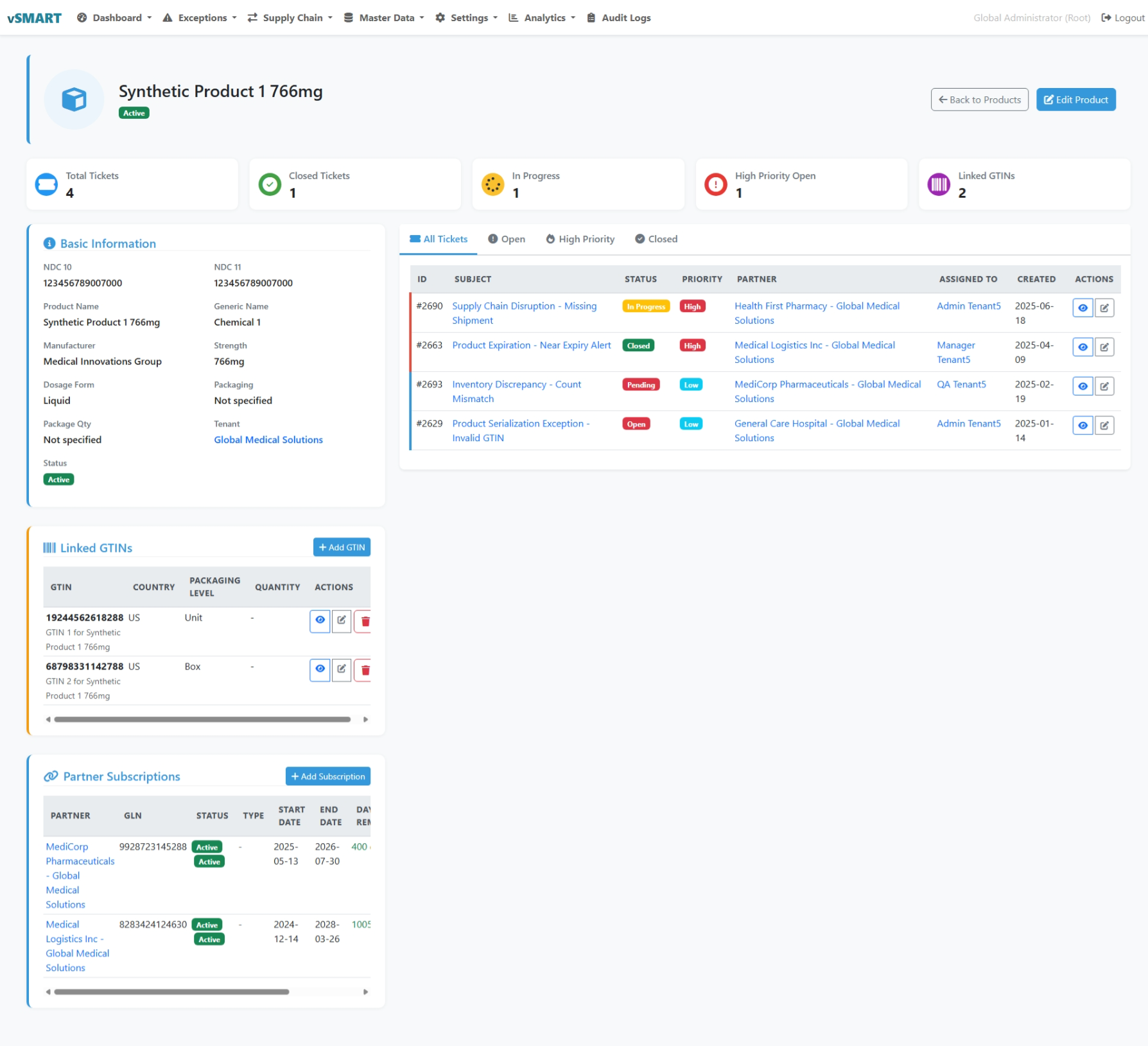
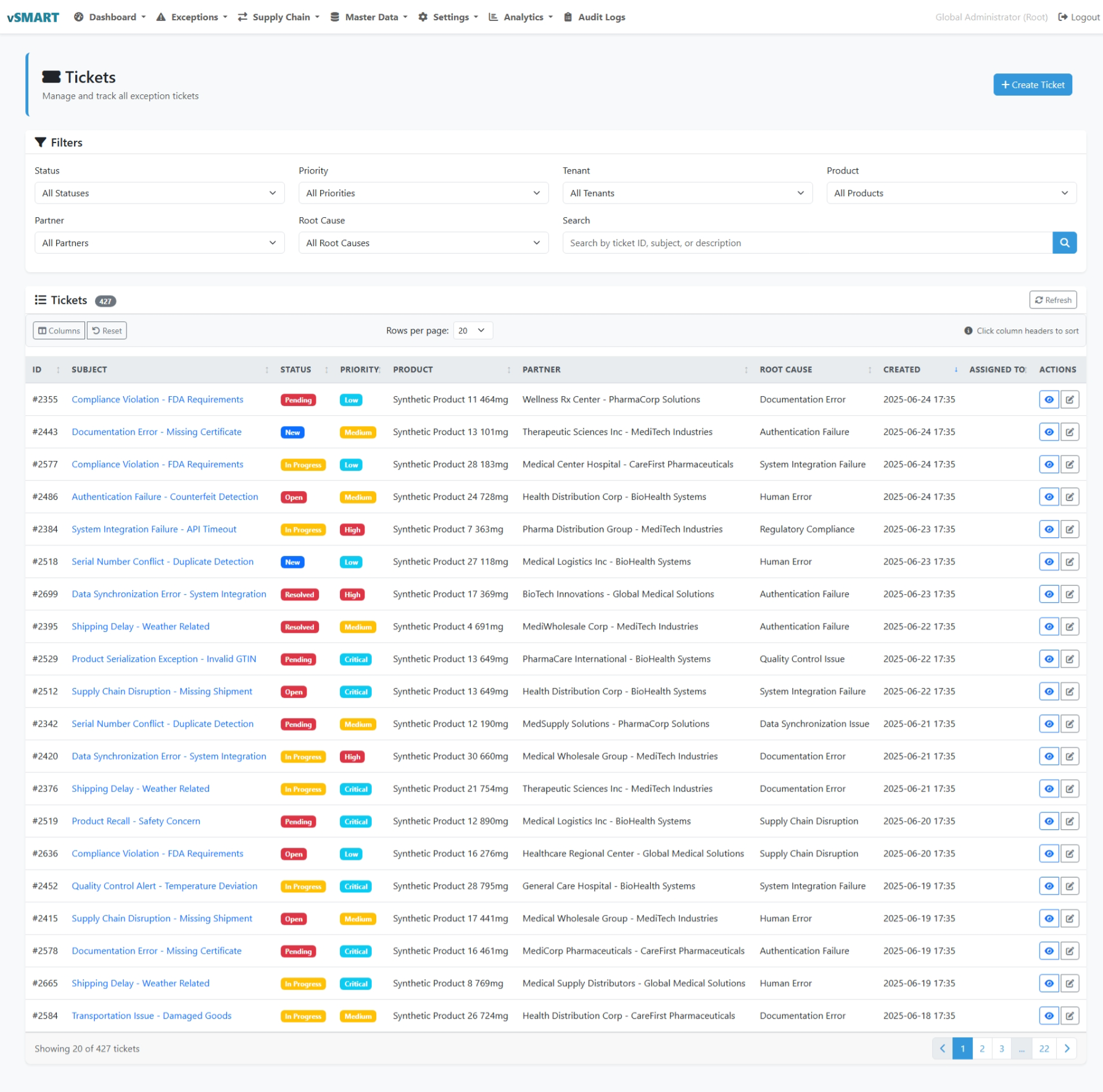
Golden Record & Master Data (SynQD)
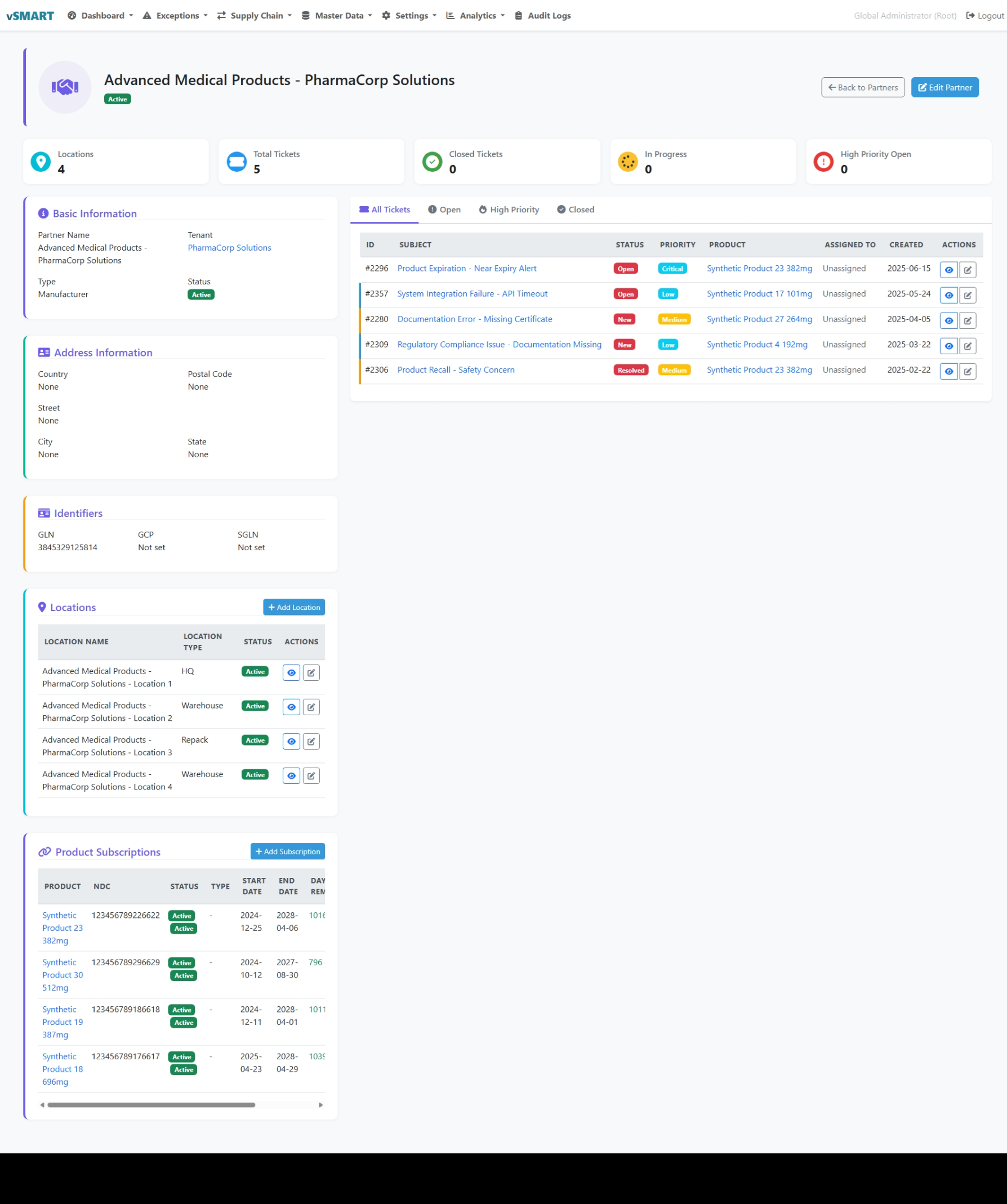
Trading Partner & Transactions (TransaQD)
A Composable Substrate, Not a Bundle of Modules
Every system you connect gets normalized to one canonical data model. Modules never call each other directly — they publish and subscribe to events on a shared spine. That's what removes reconciliation between exceptions, master data, and transactions. Not a shared database. A shared meaning.
Use-case templates and pharma domain packs — serialization, order-to-cash, 3PL operations, cold chain, quality, procurement. Composed from configuration, not code.
Extraction, classification, matching, prediction, and recommendation — a horizontal AI service tier every module calls, plus unified business intelligence across the whole platform.
The three operating modules: work and exceptions, meaning and governance, and business transactions. Each stands alone, with its own buyer and its own ROI.
The connectivity fabric and event spine every deployment runs on — not a fourth module, the substrate underneath the other three.
Party, product, location, transaction, event, and case — one object model, tenant-scoped, versioned, and fully audit-logged, that every layer above reads and writes.
ConnecQD is not a fourth pillar. It's the substrate the other three run on — which is why every deployment includes it.
Three Modules. Each Stands Alone.
Every module is independently deployable, independently valuable, and sold on its own ROI — so you can start with the problem you have today.
CheQD
Work and exceptions — the human interface of the platformEverything the system can't resolve on its own surfaces here as structured, routed, SLA-bound work with a complete audit trail. A 3PL's email becomes a case with the product, partner, and root cause already attached — before a human ever opens it.
- Multi-channel intake: email, event-triggered, API, partner portal
- AI classification into domain categories with a confidence score
- Document extraction: PDF, XLSX, EDI, EPCIS XML, scanned images
- No-code routing, escalation, and SLA rules
- Action surfaces in Microsoft Teams and Slack
- Immutable audit trail across every state change and AI decision
Entry use case: chargeback dispute resolution.
SynQD
Meaning and governance for every party, product, and locationThe semantic layer that turns connectivity into meaning. SynQD owns golden records for party, product, and location, and validates every one of them — NDC, GTIN, GLN, DEA — at the point of entry, before bad data ever spreads downstream.
- Golden record management with survivorship rules and full lineage
- Entity resolution and fuzzy matching across source systems
- Configurable validation policies with tenant-defined severity
- Change approval workflow with effective dating
- Data quality scorecards by domain, source, and partner
- Bidirectional sync with external MDM and GDSN pools
Entry use case: partner onboarding data quality, or post-acquisition catalog consolidation.
TransaQD
Business transactions, protocol-agnosticExecution of business transactions with trading partners — X12, EDIFACT, REST/JSON, flat file, or partner portal. Every transaction, inbound and outbound, is validated against governed SynQD golden records rather than transmitted as-is.
- Full transaction lifecycle: create, validate, transmit, acknowledge, reconcile, escalate
- Per-partner profiles for identifiers, transport, and business rules
- No-code partner onboarding, with a self-service partner portal
- Contract and pricing rule evaluation for chargeback and rebate variance
- End-to-end transaction visibility with live status tracking
Entry use case: faster partner onboarding, or chargeback reconciliation.
ConnecQD
The connectivity fabric — included in every deploymentPre-built connectors for L4 serialization platforms, ERP (SAP, NetSuite, JD Edwards, Dynamics 365, Oracle Cloud), WMS, TMS, and 3PL portals, plus REST/GraphQL, webhooks, SFTP/AS2, file, and email ingestion — all normalized to the canonical model on the way in.
- Mapping is metadata: a new partner variant is configuration, not a build
- Every normalized object publishes an event on the spine
- Credential vault, connection health monitoring, automatic retry
- Dead-letter queue and replay without re-transmission
- Dev / test / prod environment promotion for validated deployments
Entry use case: connect your L4 to your ERP without a six-month integration project.
AI That Knows When to Ask for Help
Every AI output in vSMAART carries a confidence score. Above your configured threshold, the platform acts. Below it, the platform pauses and routes the decision to a person — and either way, the outcome is logged with the model version and the inputs that produced it.
That single mechanism is what makes AI deployable in a regulated environment: the audit trail, the human-in-the-loop fallback, and the AI layer, owned together instead of bolted on separately.
- Extraction, classification, and root-cause detection on every inbound document
- Next-best-action and resolution recommendations, cited against similar resolved cases
- Confidence-gated auto-resolution with a human fallback built in, not bolted on
- Exception forecasting and partner risk scoring as the data accumulates
Above threshold → the platform acts
Classification, matching, or a proposed fix is applied automatically, logged with its inputs and model version.
Confidence: 0.44
Below threshold → a human decides
The case pauses, routes to the right owner in Teams or Slack, and resumes the moment a person approves — with the decision recorded in the audit trail.
One Email. Four Modules. Nothing Integrated by Hand.
A 3PL emails about a receiving mismatch. Trace it end to end — every participant only ever knows about canonical objects and events, so adding a new step later means adding a subscriber, not rewriting the flow.
See This LiveBring the Use Case. We Compose It From What's Already Built.
A use case is a composition, not a custom build — which trigger starts it, which sources feed it, which validations and AI services apply, where a human decision is required, and what actions and metrics come out the other side. A solution consultant assembles it against the canonical core; no code ships.
Pharma domain packs
Versioned bundles of pharma knowledge that configure the platform without changing it. New expertise ships as a pack, not a release.
The flywheel
- You bring a use case — your problem, in your words, on your systems.
- We assemble it from existing primitives against the canonical core, in days.
- It's generalized into the solution catalog as a reusable template.
- The next customer with a similar problem starts most of the way built.
Built for Pharma Compliance From Day One
DSCSA compliance isn't bolted on — it's baked into the canonical core. Every object carries tenant isolation, source lineage, a confidence score where AI derived the value, and an immutable version history.
DSCSA & EPCIS
Full traceability and EPCIS event support across CheQD, TransaQD, and ConnecQD, with lot, expiry, serialization, and pedigree enforced at the document level.
Audit Trail & RBAC
Every action across every module is logged with timestamp and actor. Role-based access spans Root Admin, Customer Admin, Customer User, Consultant, and Partner roles.
Enterprise Security
Multi-tenant data isolation enforced at the data layer, encryption at rest and in transit, and full audit-log export for regulatory review. SOC 2 Type II is in progress.
Built for Teams Running Enterprise Volume on a Small Team
vSMAART is built first for mid-size generic and specialty pharmaceutical manufacturers distributing through wholesalers and 3PLs — companies with enterprise-grade exception volume and a lean ops team covering serialization, EDI, and master data all at once.
Serialization & Compliance Teams
A complete, auditable record of every exception — from arrival to resolution — on top of the L4 you already run.
EDI & Supply Chain Ops
Transactions validated against governed master data, per-partner profiles, and a self-service portal for chargeback-heavy channels.
IT & Integration Leaders
Pre-built connectors for L4 platforms, ERP, and WMS, plus an open REST API, without standing up an integration team.
Executive Stakeholders
Partner scorecards you can bring into your own supplier and 3PL business reviews — cycle time, quality, and resolution in one view.
Why vSMAART
Purpose-built for pharmaceutical supply chain operations — not adapted from a generic integration or ticketing platform.
One Data Model, No Reconciliation
CheQD, SynQD, and TransaQD share the same canonical objects on ConnecQD's event spine. Nothing gets reconciled between exceptions, data, and transactions.
Purpose-Built for Pharma
NDC, GTIN, GLN, DEA, DSCSA, EPCIS, lot tracking, cold chain, and pedigree understood out of the box — pharma domain knowledge ships as versioned packs.
AI With an Audit Trail
Confidence-gated automation with a human-in-the-loop fallback, logged with the model version and inputs — deployable in a regulated environment.
Attaches to What You Have
Pre-built connectors to L4 systems, ERP, WMS, and 3PL portals mean no rip-and-replace, no migration, and no steering committee.
Every Use Case Compounds
A use case built for one customer generalizes into the solution catalog. The next engagement starts most of the way built, not from a blank page.
Multi-Tenant for Consultants
A single Consultant login manages multiple client organizations — ideal for firms running serialization and supply chain ops across several clients at once.
Bring Us Your Use Case
Tell us the problem in your words, on your systems — a chargeback backlog, a master data mess, a receiving mismatch that keeps recurring. We'll show you how it composes on vSMAART.